Saturday, June 20, 2009

Trevi Fountain - Italy

You can hear the fountain long before it comes into view. Walking with other tourists, I could almost feel the growing anticipation and excitement as we neared our destination – and once there, the sight did not disappoint a visitor. I remember a collective gasp as we rounded the corner and the full view of the Trevi fountain appeared before our eyes. It is truly a magnificent sight and one I shall never forget. It is great to see during the day, but I feel it’s best seen at night. It is absolutely charming and almost magical!

The following information was provided by:
http://www.aviewoncities.com/rome/trevi.htm

Construction of the Fountain
In 1732, Pope Clement XII commissioned Nicola Salvi to create a large fountain at the Trevi Square. A previous undertaking to build the fountain after a design by Bernini was halted a century earlier after the death of Pope Urban VIII. Salvi based his theatrical masterpiece on this design. Construction of the monumental baroque fountain was finally completed in 1762.

The Trevi fountain is at the ending part of the Aqua Virgo, an aqueduct constructed in 19 BC. It brings water all the way from the Salone Springs (approx 20km from Rome) and supplies the fountains in the historic center of Rome with water.

The Fountain
The central figure of the fountain, in front of a large niche, is Neptune, god of the sea. He is riding a chariot in the shape of a shell, pulled by two sea horses. Each sea horse is guided by a Triton. One of the horses is calm and obedient, the other one restive. They symbolize the fluctuating moods of the sea. On the left hand side of Neptune is a statue representing Abundance, the statue on the right represents Salubrity. Above the sculptures are bas-reliefs, one of them shows Agrippa, the girl after whom the aqueduct was named.

Tossing a Coin
The water at the bottom of the fountain represents the sea. Legend has it you will return to Rome if you throw a coin into the water. You should toss it over your shoulder with your back to the fountain.

Sunday, June 14, 2009

Book Signing at Barnes and Noble, Aurora.

Most people understand the temperamental weather of the Rockies. During springtime, we can often experience sun, rain, hailstones and tornadoes, all in one day! Yesterday was just such a day! Even so, there was a steady stream of customers milling around the Barnes and Noble store at the Southlands Shopping Center in Aurora, Colorado. Last weekend the shopping center was hit by a tornado and, although some damage was done, I’m glad to say the mall has reopened and ready for business.

As usual, the staff at Barnes and Noble was great and well prepared with signs advertising the book signing. Robert Aikens did a wonderful job of promoting the event, and Jack Broekstra did a super job having everything prepared for me and gave announcements during the two hour book signing. A big “thank you” to everyone at the store.
Photo left to right: Jack Broekstra, Assistant Manager and Elizabeth Wallace.

Thursday, June 04, 2009

Greensted Church, England and the Leper's Squint

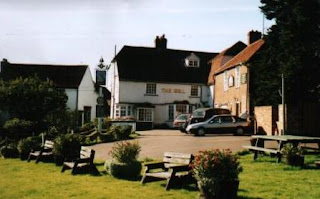
It is believed the tiny church of St. Andrew at Greensted, Essex is the oldest wooden church in the world. Located one mile from Chipping Ongar and approximately 10 miles from Epping, it appears more like a residential home than a place of worship.

The church has a rich and interesting history dating back to 1013 when an ancient chronicler recorded that the body of St. Edmund had been held overnight at Greensted Church before being taken to Bury St. Edmund, Suffolk. There are several items dedicated to St. Edmund inside the church including a beautiful stained glass window and a wood carving of a wolf guarding a severed head. A small opening in the oak wall on the north side of the church is believed to have been a Leper’s Squint, although some now think it may have been a holy water stoup.

There is an intriguing legend attached to St. Andrew’s Church. Following is an excerpt from my book Extraordinary Places...Close to London. The chapter on Greensted is located on page 49.

"He was crowned King of East Anglia on Christmas Day in the year of 855, at the tender age of 15 and died when he was only 29 years old. King Edmund was a good and virtuous ruler who cared deeply for his people but he perished at the hands of Ivar the Dane because he would not renounce his Christianity.
According to the Anglo-Saxon Chronicles (a detailed account of the history of England covering 1000 years from Roman times to the middle of the 12th century) “…a great heathen force” of Vikings arrived in 865 on the eastern shores of England known as East Anglia. They lost no time in conquering every village in their path; ravaging and pillaging until nothing was left. Then came a threatening message to King Edmund from Ivar, the captain of the Danes, “You will surrender your possessions and your people to me or die.” The king summoned his most faithful bishop for guidance but his suggestion that the king should flee was unacceptable. “…Alas bishop, I would rather die fighting so that my people might continue to possess their native land.” The bishop informed the king that word had just come from the battlefields that his armies were defeated, all was lost and surrender or flee were the only options.

The Chronicles tell us King Edmund was captured, tortured unmercifully and suffered unmentionable terrors. The Dane offered Edmund his life if he would renounce Christ. He would not, and was lashed until he almost died. With every lash he cried Jesus’ name infuriating his captors. Finally, he was tied to a tree and killed by a hail of arrows so that “…hardly a place on his body was not covered with arrows…” He was then beheaded. As a final insult, the pirates hid King Edmund’s head in the forest so that it could not be buried with his body.

Soon after King Edmund’s death, the Britons and some reformed Danes began to regard him as a saint because of his courageous life and honorable death. A shrine was erected and pilgrims traveled from all over Britain to honor this great man.

It is thought the final resting-place for the remains of Saint Edmund is a town called Bury St. Edmunds, in Suffolk, but some believe his remains are in the churchyard at St. Andrews’s church."

Wednesday, May 27, 2009

Nederland, Colorado and the Frozen Dead Man

How did Nederland, Colorado get its unusual name? Well, it began in 1871 when Abel Breed bought the silver-rich Caribou Mine and shipped the silver ore from Caribou Hill, elevation 10,000 feet down to Middle Boulder at approximately 8,000 feet because it was “warmer.”

In 1873, Breed sold the mine to a Dutch company, and the miners nicknamed the town Nederland. A year later, when the town was incorporated, the locals chose Nederland as the official name.

Nederland is notorious for the Frozen Dead Guy, who is celebrated in a winter festival each year. It seems that Bredo Morstoel, a native of Norway visited his daughter Aud and his grandson, Trygve Bauge in Boulder, Colorado. Unfortunately on his return to Norway, he would not survive a second heart attack and on November 6, 1989 died. Trygve and his mother owned land in Nederland and decided to use it as the base for a new business venture. They planned to build a cryonics storage facility and place grandpa there along with other cryonic bodies believing that one day they could be restored to life using advanced technology not yet developed. Bredo’s body was shipped from Norway to America in dry ice, processed with liquid nitrogen in California and eventually sent to Nederland.

Unfortunately, Aud and Trygve's business plan did not work out. Their visas were revoked, and they had to return to Norway leaving poor Bredo behind.

For almost 15 years, Bredo Morstoel has been in the hands of Bo Shaffer who is known locally as the Ice Man. Shaffer has been driving from Denver to Nederland hauling nearly a ton of dry ice up the mountain every month since 1995. It is an expensive trip that is paid for by the family. Mr. Bredo Morstoel still resides in his original steel coffin, packed in dry ice, surrounded by an insulated wooden box and sits in a Tuff Shed overlooking Nederland, Colorado.

For more information go to:
http://www.legendsofamerica.com/CP-FrozenDeadGuy.html
http://www.nederlandchamber.org/events_fdgd-home.html

Sunday, May 10, 2009

Wild Bill Hickok & Dead Man's Hand

Wild Bill suffered from consumption or TB as it is currently known, and so traveled west hoping the clean air would help his condition. It was not only medical reasons that drew him to Deadwood, South Dakota but also the lure of gold. Unfortunately, it would be the death of him because he died on August 2, 1876 at the hands of a drifter called Jack McCall who supposedly wanted to settle a score . He accused Hickok of killing his brother back in Kansas, and so cowardly crept up behind Hickok as he played cards, shooting him in the back of his head killing him instantly. A jury later acquitted McCall believing his story of revenging his brother’s death. McCall spent the rest of his life boasting of killing the infamous gun slinger.

The whole incident should never have happened because Wild Bill, conscious of those who wanted to kill him for the notoriety it would bring always faced the door in a saloon. Although he was ambidextrous and kept two guns in a sash around his waist, he always used his left hand to drink his whiskey leaving his right hand to draw his gun. On that fateful day, he took the only seat available at the card table, a chair that backed to the door and therefore he never saw his killer’s approach. At his death, Hickok was holding a very strong hand, a pair of aces and a pair of eights since known as the Dead Man’s Hand.


Wild Bill Hickok is buried in St. Moriah’s Cemetery, Deadwood with Calamity Jane’s burial site close by.

Wednesday, April 29, 2009

Linda Berry's Latest

Last Sunday, I had the pleasure of attending the launch of Linda Berry's latest book Death and the Crossed Wires at the Denver Woman's Press Club. It was a wonderful afternoon as Linda read a short piece from her new book and then fielded questions about the six Trudy Roundtree Mysteries she has penned over the years.

Besides being a member of the Denver Woman's Press Club, Linda is also a member of the Rocky Mountain Fiction Writers, and Sisters in Crime. She describes herself as a community arts activist and an insatiable theatre-goer.

For more information on Linda Berry's books go to: www.ogeechee.avigne.org/

Tuesday, April 21, 2009

Piracy on the Open Seas (origin Jolly Roger)

It was called the Golden Age of Piracy and had colorful characters such as Captain Kidd, Calico Jack, Blackbeard and Black Bart. These pirates roamed the open seas causing fear and creating havoc from 1698 to 1718. Just the sight of their flag, the Jolly Roger, could bring about the surrender of a much larger ship. Often, a captain would rather lose his ship and merchandise than the lives of his men.

A common tactic for a pirate captain would be to sail without displaying a flag of any kind. Then, once they were close enough for battle, the pirates would hoist their flag to intimidate the merchant vessel’s captain into submission. Over years, the color and design of the flag changed. Originally, the flag was red in color with no emblem; the color indicated the pirates would take no quarter. Later, a black flag replaced the red, and sometime later still, an individual sewed the emblem of a grinning skull complete with crossbones (sometimes cutlasses) on the black flag. Perhaps the flag became known as the Jolly Roger because a pirate’s nickname for the devil was “Old Roger” but the exact origins are unknown.

Acts of piracy were not exclusive to men; there were at least two women pirates. Mary Read and Anne Bonny masqueraded as men and by all accounts were able to manage the work and keep their identity hidden. These women played a small part in the history of piracy, but men such as Blackbeard, alias Edward Teach and Black Bart, alias Bartholomew Roberts are the subjects of legends.

Black Beard stood approximately 6’4” had long black hair and a black beard. He was known to matt his black beard into long tendrils and, to further intimidate his opponents, he would push hemp cords under the brim of his hat and then light the bottom so the cords appeared like a mane. These slow burning fuses around Blackbeard’s head gave him an even more menacing appearance. Blackbeard’s pirate flag had a distinct design. His flag displayed a full skeletal figure holding an hourglass in one hand and a weapon pointing towards a bleeding heart in the other.

Blackbeard favored the seas around South Carolina and was anchored at Ocracoke Island in his sloop, the Adventure, when his career ended. It was here that he died after a battle with Lieutenant Robert Maynard, Captain of the HMS Pearl. It is believed that Blackbeard had been drinking heavily and this may have helped in his demise. Later, on examination of his body, it was determined that his death resulted from 5 gunshot and at least 20 stab wounds. Legend has it that Blackbeard’s crew fulfilled their captain’s request should he die in battle. Those instructions were to remove his head and throw his body overboard. It is said Blackbeard’s headless body swam around the ship several times before it sank to its watery grave.

Bartholomew Roberts, alias Black Bart, was a completely different character to Blackbeard. Black Bart dressed immaculately, supposedly drank only tea (although this cannot be substantiated) and rarely used profanity. He ruled his crew with fierce determination and had them adhere to a code of conduct that included a disability clause stating that any crewman losing a limb or becoming unable to work due injury in battle would receive a portion of the bounty commensurate with the injuries received.

Roberts’ career in piracy lasted only four short years but he was extremely successful seizing over 400 ships. At one time, he had over 500 men manning four ships. Black Bart lost is life in battle after being hit in the throat by cannon fire. His crew weighted his body and threw it overboard in accordance with his previously stated wishes.
Black Bart’s motto: A merry life and a short one.